
Stamford Arrest Records and Court Charges
For Stamford, the arrest side and the court-charge side are maintained by different official channels. Stamford Police may create the incident or arrest report, and the Stamford Police Records Division accepts report requests by email at spdrecords@stamfordct.gov or in person at 725 Bedford Street. The Records Room public hours in the research are Tuesday and Thursday, 11:00 a.m. to 7:00 p.m. Most police reports can be obtained within 3 to 5 business days from the incident date, but arrest-report availability depends on the case's court status.
The charge record begins when the criminal or motor-vehicle matter appears in Connecticut Judicial Branch criminal portals for Stamford G.A. 1 or the Stamford/Norwalk Judicial District. Court charges after arrest can show a docket number, court location, charge category, pending or disposed status, hearing date, bond or bail events, and later disposition. For booking or custody status, use inmate records; for the full case file and outcome, use criminal court records.
The official Public Defender Services geographical-area office list identifies the Stamford/Norwalk G.A. public defender channel for defendants who qualify for assigned counsel.
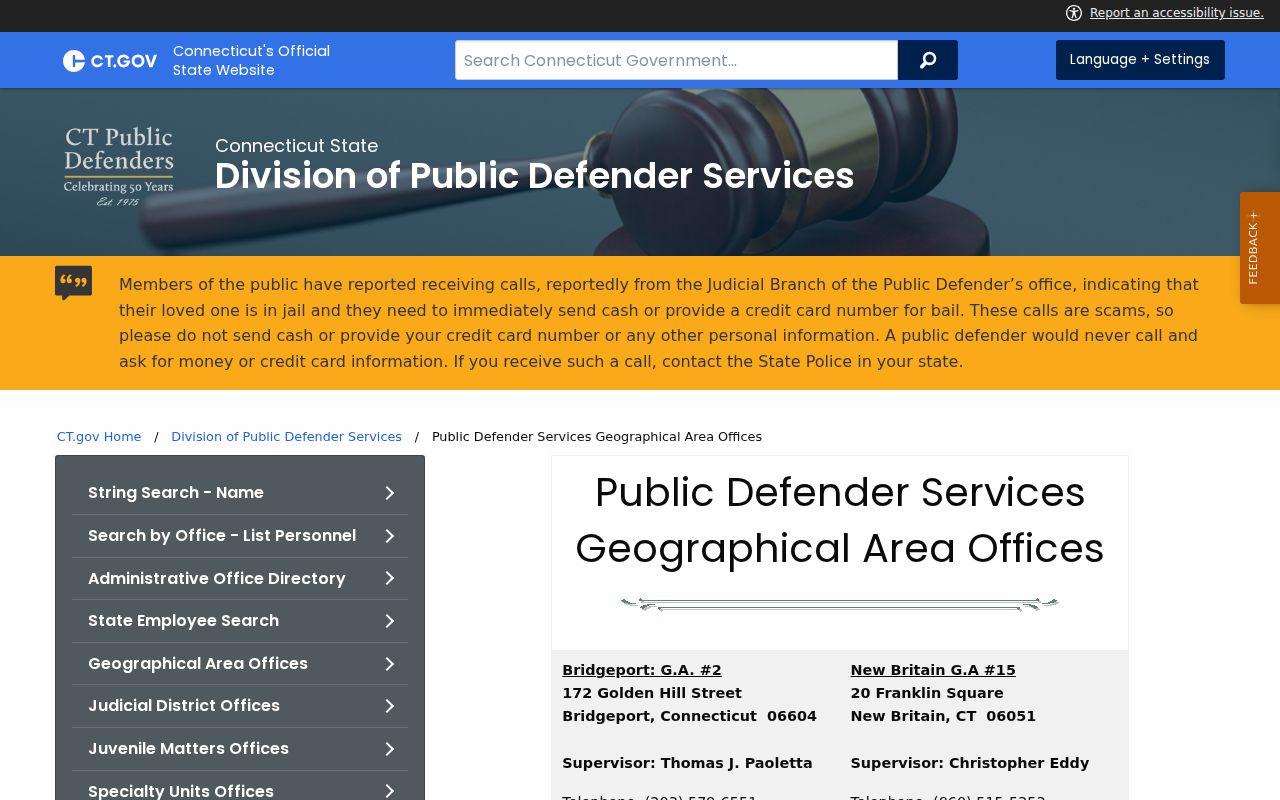
That office list matters because the charge record often becomes urgent at arraignment, bail review, or a first court appearance after arrest.
How to Find Stamford Arrest Records and Charges
Start with the record owner that matches the question. Use Stamford Police Records for police reports and incident records. Use the Judicial Branch criminal/motor vehicle portals for filed charges, daily dockets, pending cases, and convictions. Use the Clerk's Office at 123 Hoyt Street for certified copies, older files, or records not fully available online.
- Open the Judicial Branch pending criminal/motor vehicle defendant search and enter the last name, with first initial and birth year when available.
- Filter the location to Stamford G.A. 1 or Stamford J.D. when the case is local to Stamford.
- Use docket-number search if the ticket, summons, or case number is already known.
- Review each charge, court location, next event, and status, then compare that information to any police-report request.
- Contact G.A. 1 at 203-965-5208 or the Stamford/Norwalk J.D. clerk at 203-965-5308 for copy procedures and record limits.
The Connecticut conviction search is narrower than the pending case search. It shows disposed criminal and motor-vehicle conviction information and warns that records can change because of erasures, corrections, pardons, and modifications. A missing conviction result does not prove that no arrest occurred or that no pending charge exists.
Arrest Record, Charge Record, and Case File Compared
The most common mistake is treating the police report, charge list, and criminal case file as the same record. In Stamford, they may connect to the same event, but each is maintained through a different public access path.
| Record | Primary owner | What it usually shows | Best access path |
|---|---|---|---|
| Arrest or police report | Stamford Police Records | Incident details, responding agency, report identifiers, and release limits tied to court status. | Email spdrecords@stamfordct.gov or visit Records at 725 Bedford Street. |
| Court charge record | Connecticut Superior Court | Charges filed after arrest or summons, docket number, court location, status, and next event. | Judicial Branch pending, docket, daily docket, and conviction searches. |
| Criminal case file | Clerk of the Superior Court | Pleas, motions, orders, disposition, sentence, and post-judgment activity. | Online portals first, then the Stamford clerk for copies or certification. |
| Custody record | Connecticut DOC | Current incarceration or supervision information after DOC custody begins. | DOC inmate search by DOC number, name, or date of birth. |
How Charges Get Filed After an Arrest
After a Stamford arrest, a person may be released, held for court, or brought into the criminal/motor-vehicle process. The formal charge record is the court-facing accusation, not the officer's entire report. Connecticut records may show a summons, complaint, information, substituted charge, nolled charge, or disposed conviction depending on the stage of the case.
| Police arrest report | Prosecutor or court charge | Conviction record | |
|---|---|---|---|
| Purpose | Documents the incident and law-enforcement action. | States the allegation filed in court. | Shows a guilty finding, plea, or legal responsibility. |
| Timing | Created near the incident or arrest. | Appears after filing or docketing. | Appears after final disposition. |
| Public limits | May depend on investigation and court status. | May be public unless sealed, erased, juvenile, or restricted. | Can change after erasure, pardon, correction, or modification. |
Charge Status and What It Means
Charge status can change several times. A Stamford criminal portal result may show a pending case before arraignment, a later amended or substituted charge, a dismissed count, or a conviction result. The daily docket is only a calendar tool, while pending and conviction searches answer different questions.
| Status | What It Means | Where to verify |
|---|---|---|
| Pending | The charge has not reached final disposition. | Pending defendant or docket-number search. |
| Amended or substituted | The filed allegation changed from the original arrest or earlier charge. | Case docket and clerk copy request. |
| Dismissed | The court ended that charge without a conviction. | Disposition record, subject to erasure rules. |
| Nolle prosequi | The prosecutor declined to proceed at that time. | Disposition and erasure analysis under Connecticut law. |
| Conviction | A guilty plea, no-contest equivalent, verdict, or legal responsibility was entered. | Criminal/motor-vehicle conviction search and clerk records. |
The Public Defender Services judicial district office list identifies the Stamford/Norwalk J.D. public defender office at 123 Hoyt Street for eligible defendants in judicial district matters.
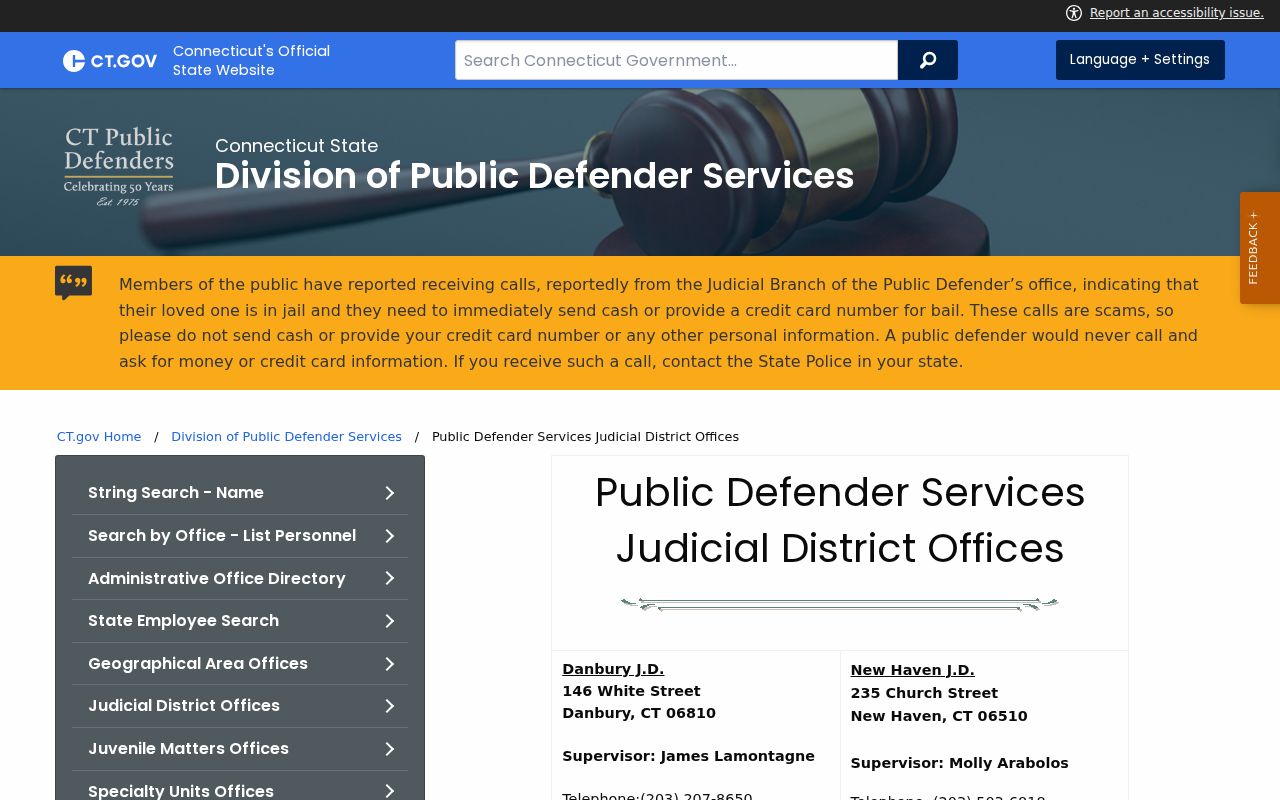
That judicial district contact is separate from the G.A. office and can matter when a charge moves into the more serious Part A or judicial district track.
Charges vs. Convictions
Being charged is not the same as being convicted. A charge is an accusation in a pending or filed case. A conviction is a final criminal or motor-vehicle outcome after a plea, verdict, or legally equivalent disposition. Stamford searchers should read the disposition field before making any conclusion about outcome.
| Charge | Conviction | |
|---|---|---|
| Stage | Accusation after arrest, summons, or filing. | Final guilt or responsibility outcome. |
| Proof level | Based on probable cause or charging decision. | Requires plea, verdict, or equivalent final result. |
| Can change | Can be amended, reduced, dismissed, or nolled. | Can later be corrected, pardoned, modified, or erased if eligible. |
| Search tool | Pending case and daily docket searches. | Conviction search and clerk records. |
Sealed, Erased, and Restricted Charge Records
Connecticut usually uses the term erasure rather than expungement. Conn. Gen. Stat. Sec. 54-142a and Clean Slate rules can remove eligible dismissals, acquittals, nolles after the applicable period, and some convictions from public access. Juvenile matter records are confidential under Conn. Gen. Stat. Sec. 46b-124, and a judge may seal all or part of a case.
| Sealed | Erased | |
|---|---|---|
| Public visibility | Hidden or limited by court order. | Treated as unavailable to the public under Connecticut erasure law. |
| How it happens | Usually by judge's order or statutory restriction. | By statute, Clean Slate automation, or petition depending on date and eligibility. |
| Stamford access point | Clerk review at the proper Superior Court location. | Clerk, Clean Slate petition path, or statutory erasure review. |
Statewide Charge and Defense Resources
The Stamford/Norwalk State's Attorney prosecutes criminal matters for Stamford and surrounding towns in the judicial district. David R. Applegate was appointed Stamford/Norwalk State's Attorney on May 7, 2026 for an eight-year term. Public defender offices at 123 Hoyt Street list telephone numbers 203-965-5245 for the J.D. office and 203-965-5241 for the G.A. 1 office.
The official Stamford/Norwalk public defender contact page gives the courthouse location and office contact details for both Stamford/Norwalk public defender offices.
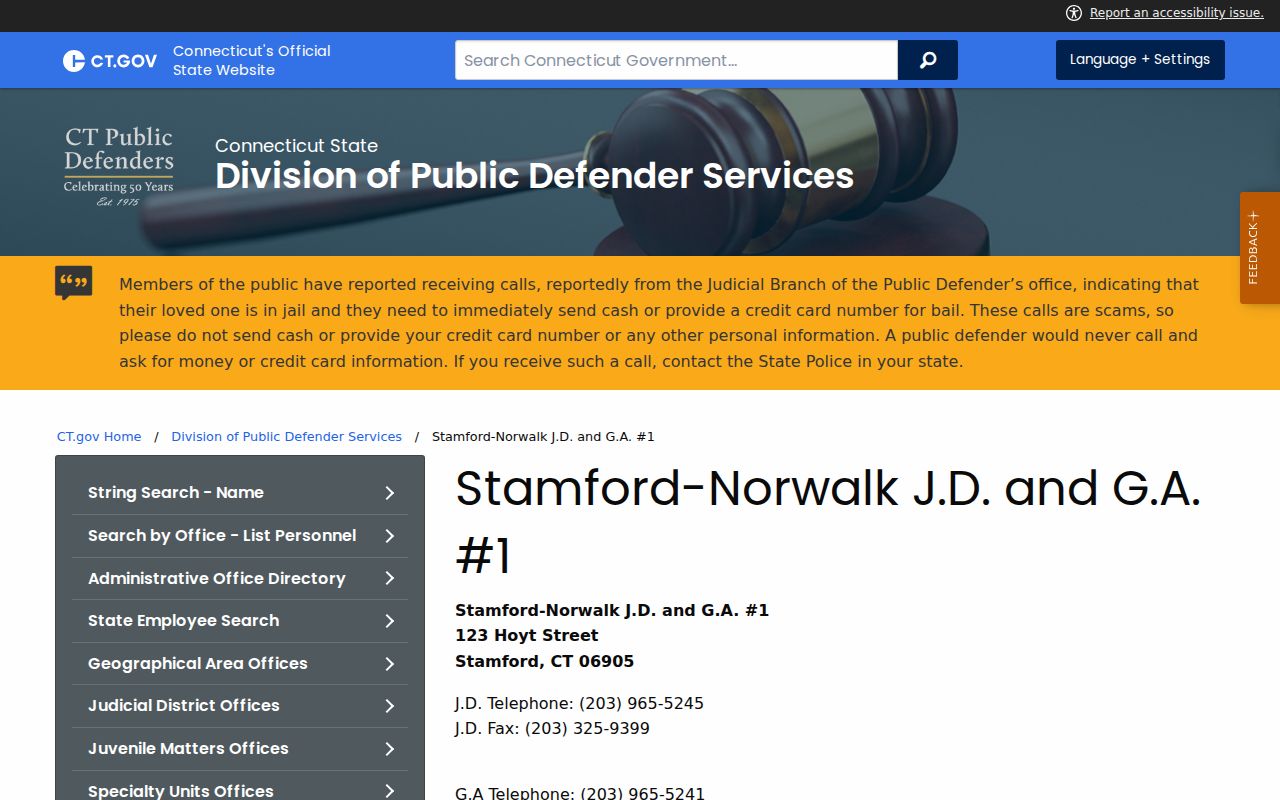
Use those contacts for counsel-related questions, not as a public warrant or arrest-record search desk.
Background Check Considerations
Public charge lookups are not the same as FCRA-compliant employment, tenant, credit, or insurance background checks. A casual public search may miss sealed, erased, federal, out-of-state, or recently changed information, and it may show charges that were never convictions.
Important: This website is not a consumer reporting agency and cannot be used for FCRA-regulated decisions.