
Stamford Criminal Court Records
A criminal court record is the case-level file kept by the court after charges are filed. In Stamford, that file usually belongs to the Connecticut Superior Court system through Geographical Area 1 at Stamford or the Stamford/Norwalk Judicial District. It can include the docket number, defendant, court location, charges, arraignment events, bond or bail notes, attorney appearances, motions, hearings, pleas, trial activity, disposition, sentence, probation, and post-judgment events.
G.A. 1 handles many criminal, motor vehicle, and arraignment matters. The Stamford/Norwalk Judicial District handles serious criminal cases and broader judicial district work. The Division of Criminal Justice describes Part A court as handling more serious criminal cases, including class A and class B felonies, from communities in the Stamford/Norwalk Judicial District. For a closer look at charge records after an arrest, use the court charge records page; for all case types, use the Stamford court records page.
Search Stamford Criminal Court Records
The Connecticut Judicial Branch criminal and motor vehicle system separates daily dockets, pending cases, docket-number searches, and convictions. Use the daily docket by court or defendant for today's or near-term calendars. Use pending case search for active matters. Use docket-number search when the docket number is known. Use conviction search for disposed conviction records, keeping in mind that the Judicial Branch warns criminal-history information can change because of erasures, corrections, pardons, and modifications.
- Start with the pending defendant search when a Stamford criminal case may still be open.
- Filter by Stamford G.A. 1 or Stamford J.D. when the court location is known.
- Use the docket-number search if a summons, ticket, notice, or prior docket entry lists the number.
- Check the daily docket by court or defendant for scheduled appearances.
- Use conviction search only for conviction records, not for every arrest or pending charge.
- Call the G.A. 1 clerk or Stamford/Norwalk Judicial District clerk for certified copies or file-access questions.
The Connecticut criminal records and erasure statute chapter is central to understanding why some Stamford criminal court records may disappear from public access.
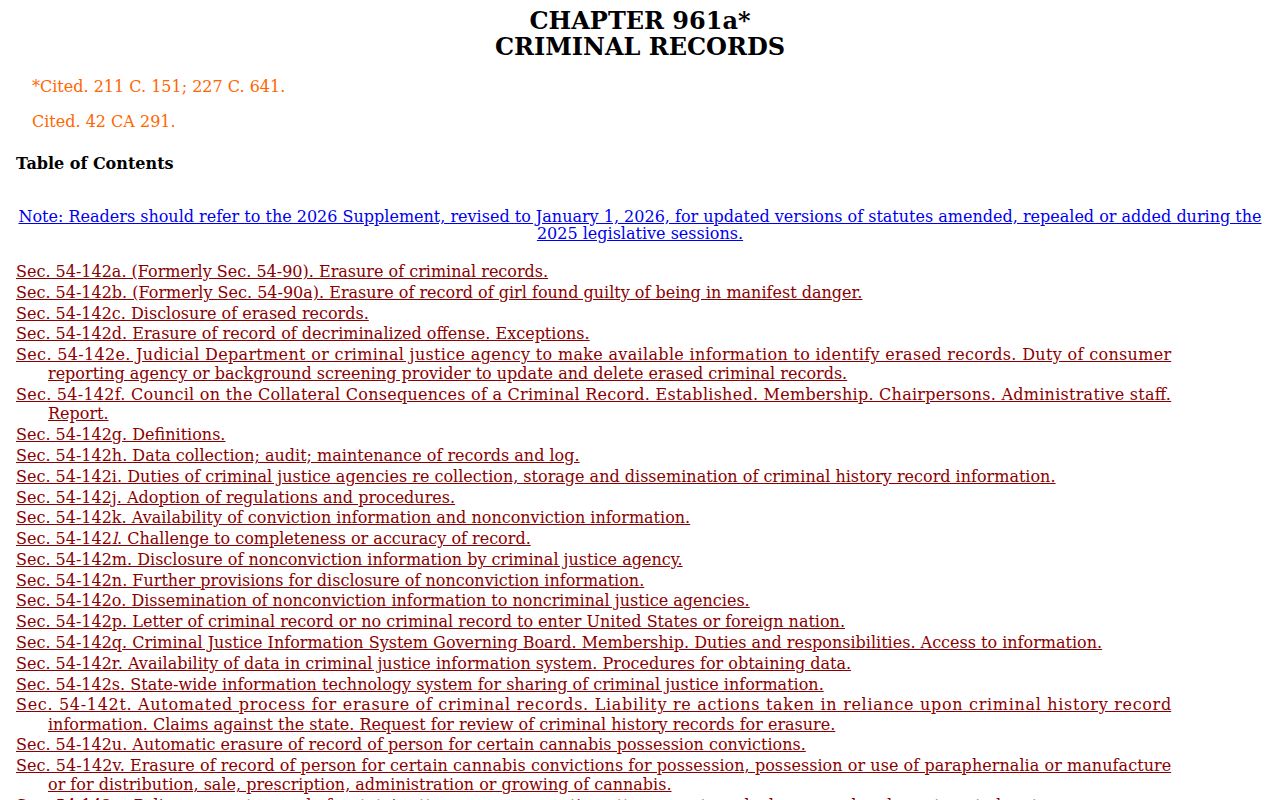
Erasure law affects whether dismissed, acquitted, nolled, or eligible conviction records remain visible in public criminal court searches.
Stamford Criminal Case Flow
Criminal court records change as a case moves through court. An early docket may show charges and arraignment. Later entries may show motions, plea discussions, trial settings, disposition, sentence, probation, or post-judgment activity. Police reports and booking records are separate source records, while the court record follows what was filed and acted on in court.
Case flow: Charges Filed › Arraignment › Pretrial / Motions › Plea or Trial › Disposition › Sentencing
| Stage | What Happens |
|---|---|
| Charges Filed | The prosecutor or charging authority brings allegations into court after arrest, summons, or warrant activity. |
| Arraignment | The court addresses charges, plea posture, release conditions, bond, protective orders, or next dates. |
| Pretrial / Motions | Attorneys file motions, review discovery, discuss resolution, and prepare for hearing or trial. |
| Plea or Trial | The case may resolve by plea, trial verdict, dismissal, nolle, or other court-approved outcome. |
| Disposition | The court records the outcome of each charge or case. |
| Sentencing | The court imposes jail, probation, fine, conditional discharge, program terms, or other lawful sentence where applicable. |
Stamford Criminal Record Fields
A Stamford criminal court record can contain public index fields and court-event fields. The online lookup is often enough to confirm the case location, pending status, disposition, and next date. It is not always enough to prove the exact legal outcome for employment, licensing, immigration, custody, or restoration purposes. Certified copies come from the clerk, and restricted records may require a court order or may be unavailable to the public.
| Field | What It Shows |
|---|---|
| Docket Number | The unique Connecticut Superior Court criminal or motor vehicle case identifier. |
| Defendant | The person charged in the criminal or motor vehicle case. |
| Court Location | Stamford G.A. 1, Stamford Judicial District, or another listed court location. |
| Charges | The alleged offenses as filed, amended, dismissed, nolled, or resolved. |
| Arraignment and Events | Scheduled dates, continuances, motions, hearings, and case activity. |
| Plea | Guilty, not guilty, nolo contendere, or other plea posture where public. |
| Disposition | Conviction, dismissal, acquittal, nolle, transfer, or other outcome. |
| Sentence | Fine, incarceration, probation, conditional discharge, or other sentence terms where public. |
Stamford Charges vs Convictions
A charge is an allegation filed in court. A conviction is an outcome based on a guilty plea, no-contest plea with legal effect, or verdict. A Stamford criminal court record may show charges that were changed, reduced, dismissed, nolled, or ended in acquittal. Reading only the first charge line can lead to a wrong conclusion if later docket entries changed the case.
| Charge | Conviction | |
|---|---|---|
| Meaning | An accusation or filed offense. | A final finding or plea outcome with legal effect. |
| Timing | Appears early after arrest, summons, warrant, or prosecutor filing. | Appears after plea, verdict, or final disposition. |
| Possible Change | Can be amended, reduced, dismissed, or nolled. | Can later be affected by erasure, pardon, correction, or modification. |
| Best Search | Pending criminal and daily docket searches. | Conviction search and certified clerk records. |
The Connecticut juvenile matters confidentiality chapter explains why juvenile criminal or delinquency-related records are not treated as open public criminal records.
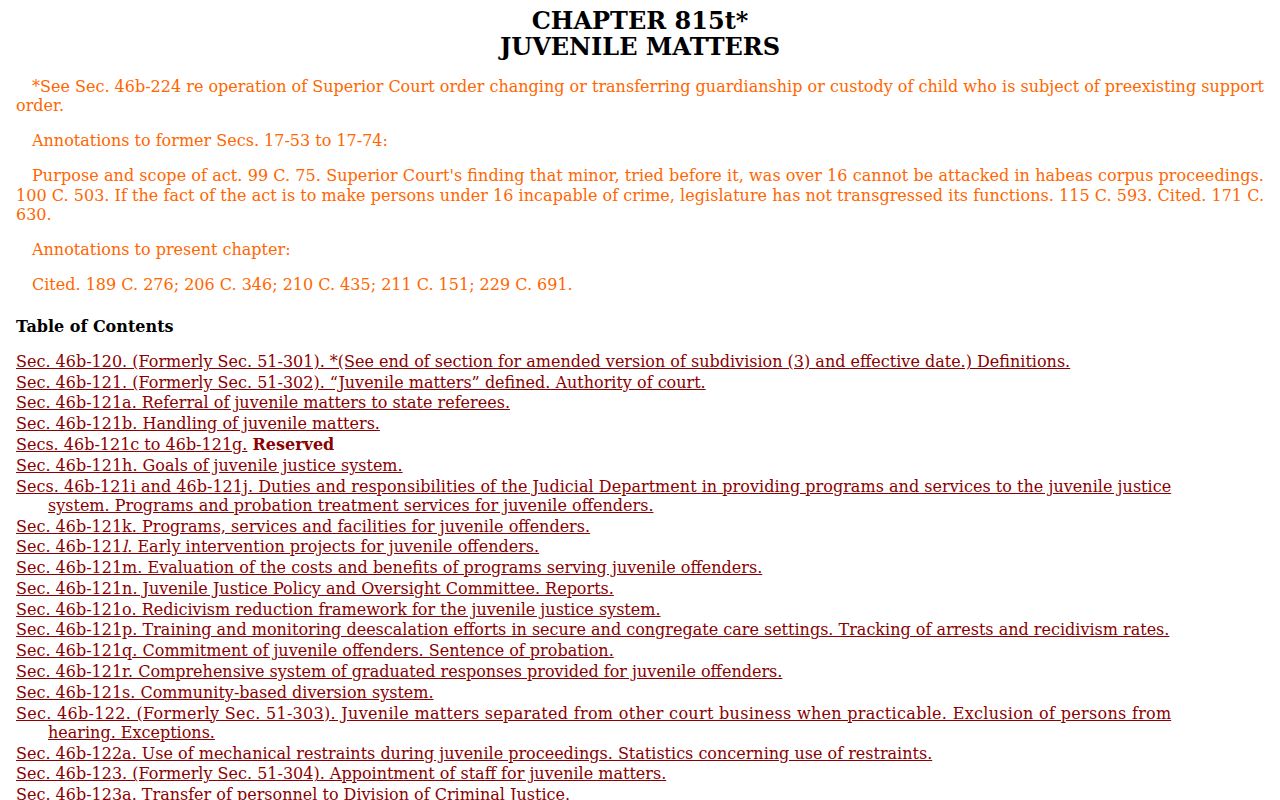
Juvenile confidentiality is a major exception to public criminal court access, even when a family or incident has Stamford connections.
Stamford Prosecutor and Defense
Connecticut criminal prosecution is handled by State's Attorneys. Stamford criminal cases fall within the Stamford/Norwalk Judicial District. The Division of Criminal Justice states that the district serves Darien, Greenwich, New Canaan, Norwalk, Stamford, Weston, Westport, and Wilton. The current State's Attorney reference matters because older pages may still list prior leadership.
The Public Defender Services offices at 123 Hoyt Street include a Stamford/Norwalk Judicial District office and a G.A. 1 office. Public defender contacts are not record custodians, but they are important when a defendant is represented, needs eligibility review, or has questions about active case defense. For the file itself, the clerk remains the records point of contact.
The Stamford/Norwalk State's Attorney page identifies the prosecution office connected to Stamford criminal court records.
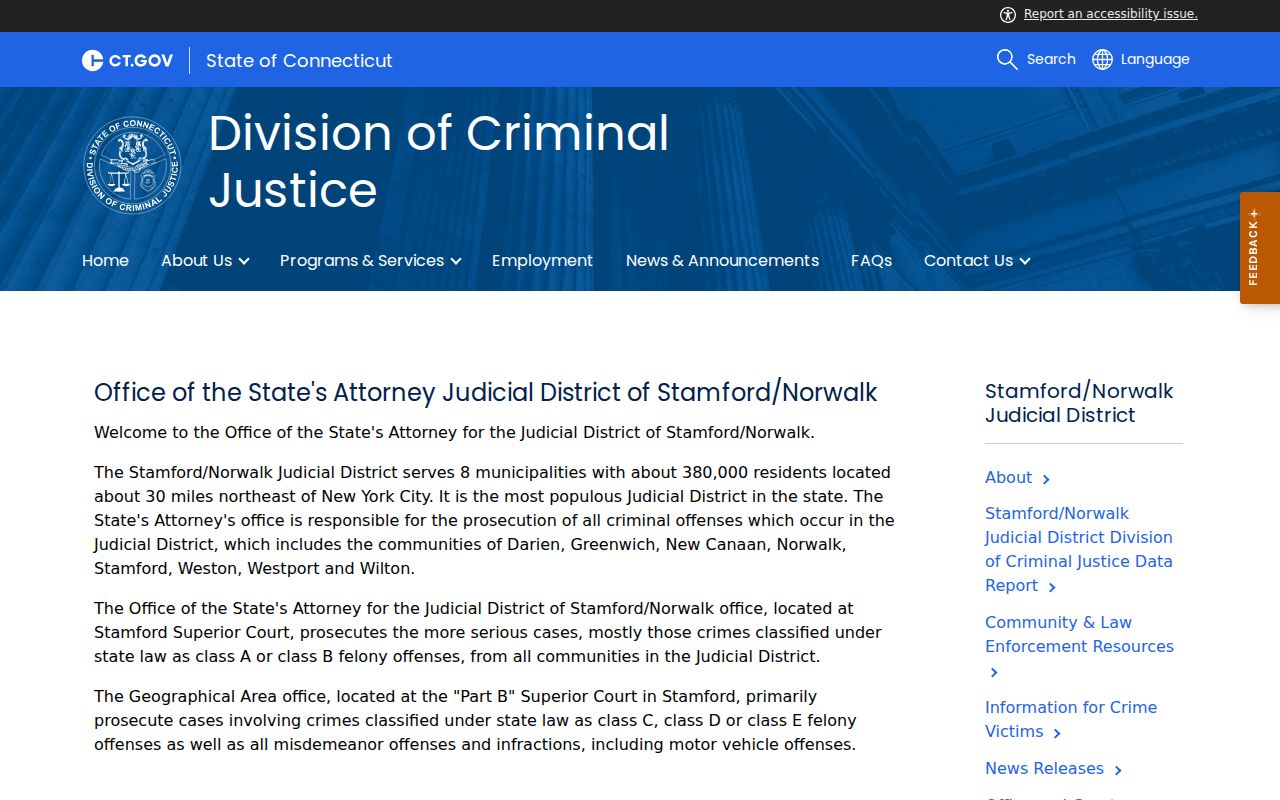
Prosecutor office pages help explain which judicial district handles charges, but they are not a public case search portal.
The State's Attorney Stamford/Norwalk court locations page describes court locations and Part A criminal case handling.
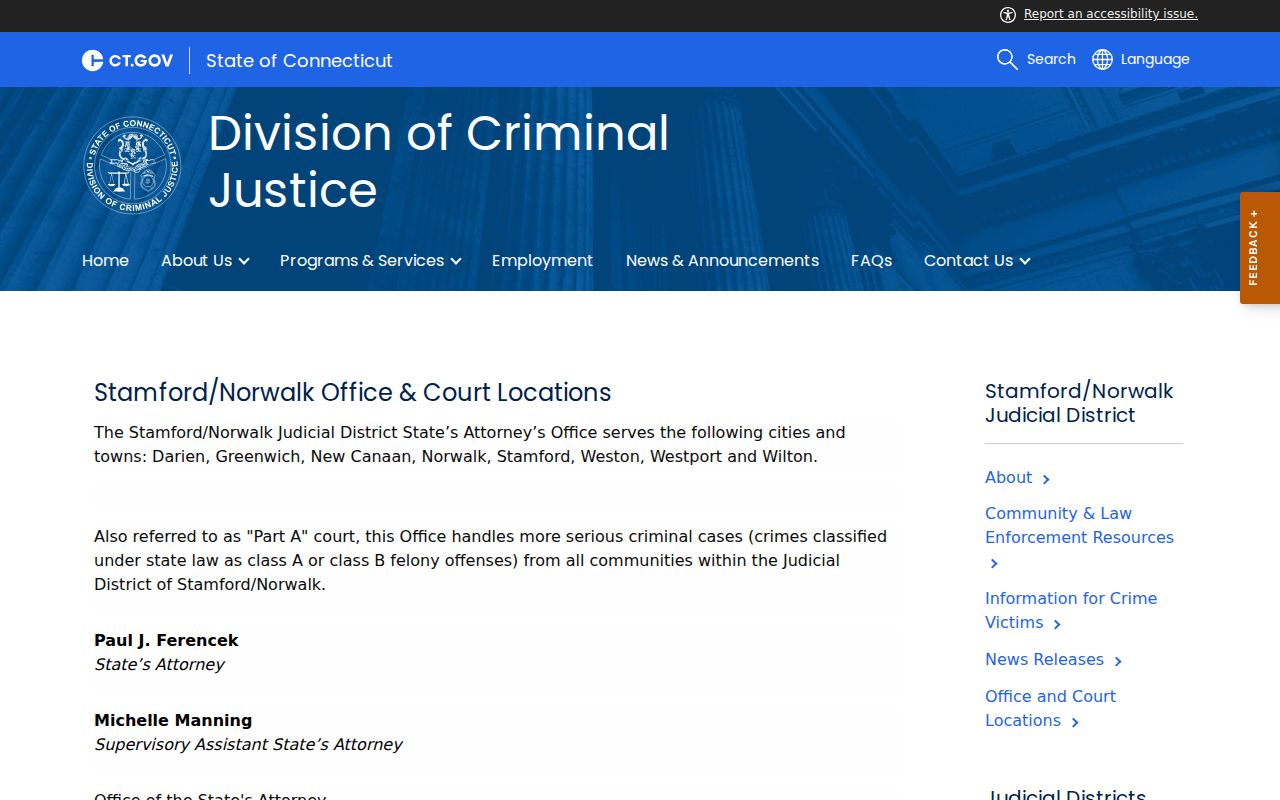
Location details help separate Stamford G.A. matters from judicial district criminal records and more serious Part A cases.
Read Dispositions and Sentences
The disposition is the outcome of a charge or case. Common outcomes include guilty, not guilty, dismissed, nolled, acquitted, transferred, or disposed by another court order. A sentence is the consequence imposed after a conviction or plea. It may include incarceration, probation, a fine, conditional discharge, restitution, program conditions, or other lawful terms. Motor vehicle matters may also have DMV reporting consequences.
Do not treat a pending charge as a sentence. Do not treat a daily docket entry as a final outcome. A Stamford criminal court record should be read from charge filing through final disposition, and then checked for later erasure, correction, pardon, or modification. For official proof, ask the Clerk of the Superior Court how to request a certified disposition or certified copy.
Note: The conviction search page states criminal-history information may change after erasures, corrections, pardons, and modifications.
Sealed vs Erased Records
Connecticut research should usually use the term erasure rather than expungement. Erasure can remove eligible criminal records from public access under Connecticut law, including certain dismissals, acquittals, nolles after the applicable period, and eligible convictions under Clean Slate rules. Sealing is different. A sealed record or sealed filing is restricted by court order or law, and the clerk cannot release it to the public without proper authority.
| Sealed | Erased | |
|---|---|---|
| Public Visibility | Hidden or limited by court order or legal restriction. | Treated as unavailable to the public under erasure rules. |
| Common Source | Judge's order, confidentiality law, safety rule, or protected proceeding. | Conn. Gen. Stat. Sec. 54-142a and Clean Slate eligibility. |
| What Search Shows | May show a limited shell or no public entry. | May disappear from public criminal searches. |
| Access Path | Usually requires court authority. | Use statutory or Clean Slate process if eligible and not automatic. |
The Connecticut Clean Slate petition guidance explains the petition route for eligible convictions imposed before January 1, 2000.
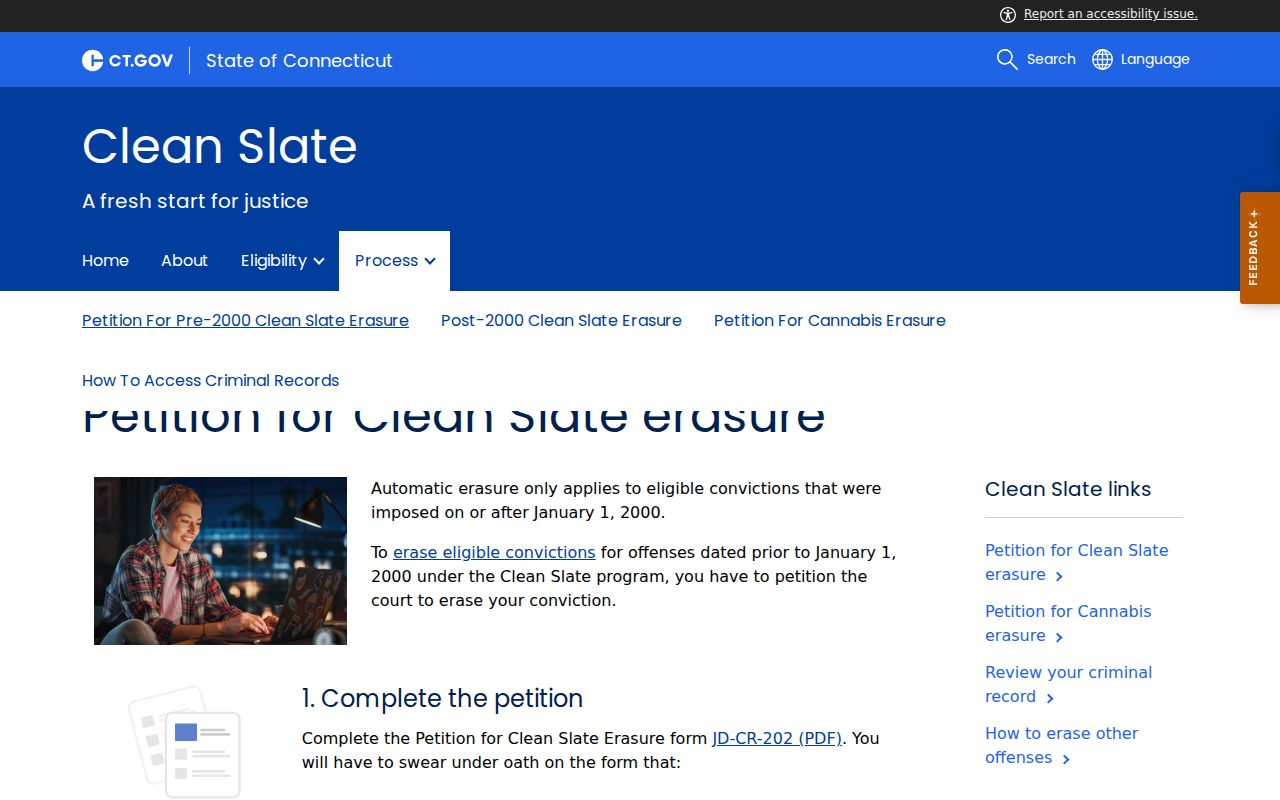
Clean Slate can affect whether a Stamford conviction remains publicly visible, but eligibility depends on the conviction and date.
Public Access to Stamford Criminal Records
Public access to Stamford criminal court records is broad but not unlimited. Court case data is searched through Judicial Branch tools, while city police reports are requested from Stamford Police Records under municipal procedures. Connecticut FOIA can apply to public agency records, but it does not override sealed court records, juvenile confidentiality, erasure law, or judge-imposed restrictions. Juvenile matters, erased cases, sealed filings, protected addresses, and sensitive family-violence information may be restricted.
Key Statutes:
Conn. Gen. Stat. Sec. 54-142a governs criminal-record erasure for records that meet statutory criteria.
Conn. Gen. Stat. Sec. 46b-124 makes juvenile matter records confidential except for listed statutory access.
The May 7, 2026 appointment notice for David R. Applegate is a current official reference for Stamford/Norwalk State's Attorney leadership.
Current prosecutor references help avoid outdated Stamford criminal court content, especially after the 2026 leadership change.
Restricted Stamford Criminal Records
Restricted criminal court records include juvenile matters, erased records, sealed cases, sealed warrants, safety-sensitive family-violence material, and records limited by order or statute. Stamford Police arrest reports may also be limited by case status, and the Stamford Police research notes that report availability in arrest situations depends on the court status of the case. If the public search does not show a known case, the record may be restricted, erased, filed under another court location, or not yet updated.
The clerk can explain process and file location, but cannot give legal advice or release sealed material without authority. G.A. 1 criminal and motor vehicle clerk questions go to 203-965-5208. Stamford/Norwalk Judicial District clerk questions go to 203-965-5308. Bail Services at the courthouse is listed at 203-965-5248 for release and bond process questions.