
What Stamford Court Dockets Show
A docket is the court's running schedule or event record for a case. In Stamford, that can mean a daily criminal or motor vehicle docket for G.A. 1 or the Stamford Judicial District, a pending criminal case record, a civil court event by location, or a Superior Court legal notice. A docket helps answer practical questions: where the case is, whether it is pending, what the next date is, and which court location is involved.
A docket is narrower than the full case record. It may list a hearing, charge, party name, court location, notice date, or disposition. It usually does not give the full complaint, motion papers, exhibits, transcript, or certified judgment. For full case material, use the docket number to ask the Clerk of the Superior Court for copy rules and file availability.
Daily Stamford Criminal Dockets
Daily criminal and motor vehicle dockets are searched through Connecticut Judicial Branch criminal docket tools. Search by court location when the hearing date and court are the main concern, or search by defendant when the name is known. Stamford court users should look for Stamford Geographical Area 1 and Stamford Judicial District options, because the same courthouse serves different functions.
- Open the Judicial Branch criminal and motor vehicle docket search by court.
- Select the Stamford court location that matches the case or notice.
- Review the daily list for defendant name, docket number, event, courtroom, or scheduled time where shown.
- Use the defendant or docket-number tools if the daily docket does not show the case.
- Contact the G.A. 1 clerk for criminal and motor vehicle questions that require confirmation.
The daily docket search by defendant is useful when the court date is near but the exact Stamford calendar is not known.
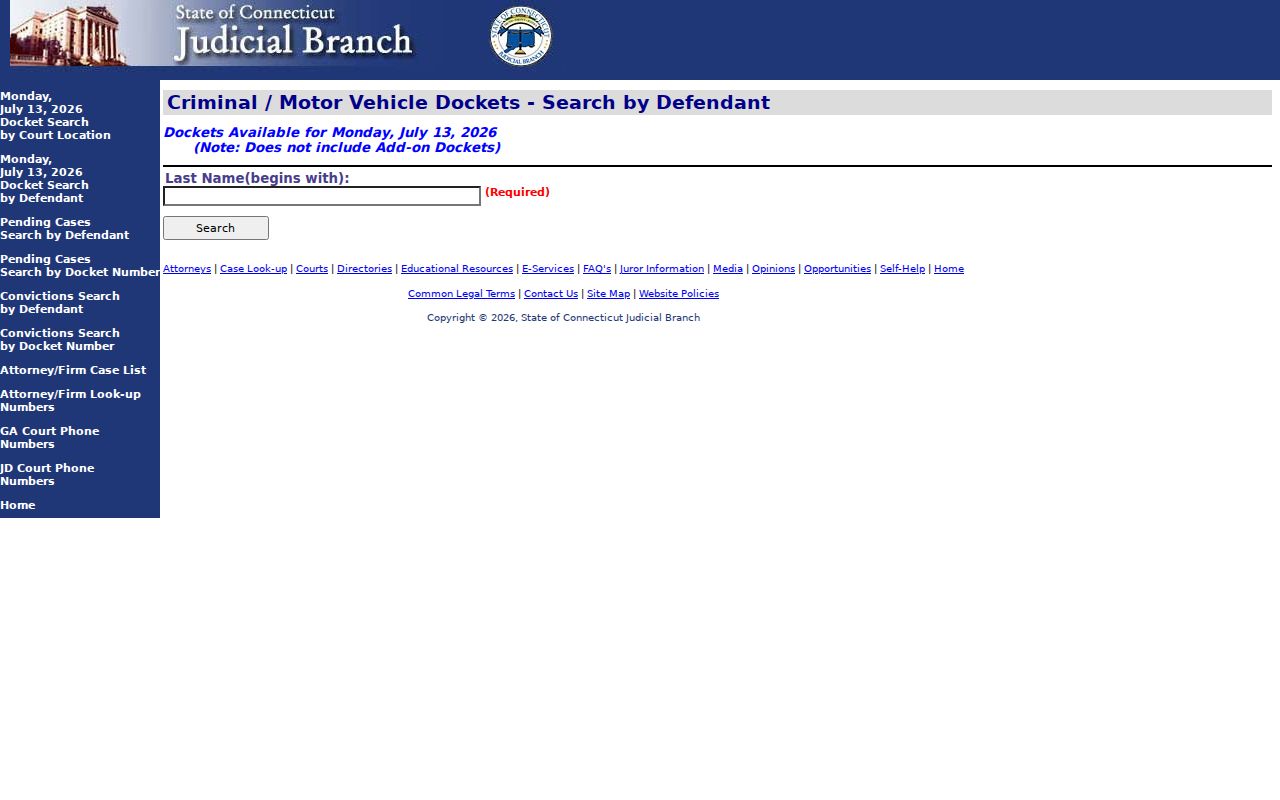
Name-based daily searches are date-sensitive, so they should be paired with pending case lookup for broader Stamford criminal docket research.
Pending Stamford Criminal Dockets
Pending criminal and motor vehicle docket tools are better for active cases that may not appear on a single day's calendar. The defendant search uses a required last-name field and optional narrowing fields such as first initial, birth year, year range, court location, and category. The docket-number search is better when a ticket, summons, court notice, or older docket entry already lists the number.
| Field Label | Type | Required | Notes / Format |
|---|---|---|---|
| Last Name (begins with) | Text | Yes | Required for defendant searches. |
| First Initial | Text | No | One-character narrowing field observed. |
| Birth Year | Text | No | Four-digit year can help with common names. |
| Court Location | Dropdown | No | Includes Stamford G.A. 1, Stamford J.D., Norwalk, Bridgeport, Danbury, and other locations. |
| CategoryType | Dropdown | No | Includes Criminal, Motor Vehicle, and referred motor vehicle or boat license and registration suspension options. |
The pending criminal and motor vehicle defendant search is the main active-case lookup for Stamford criminal dockets.
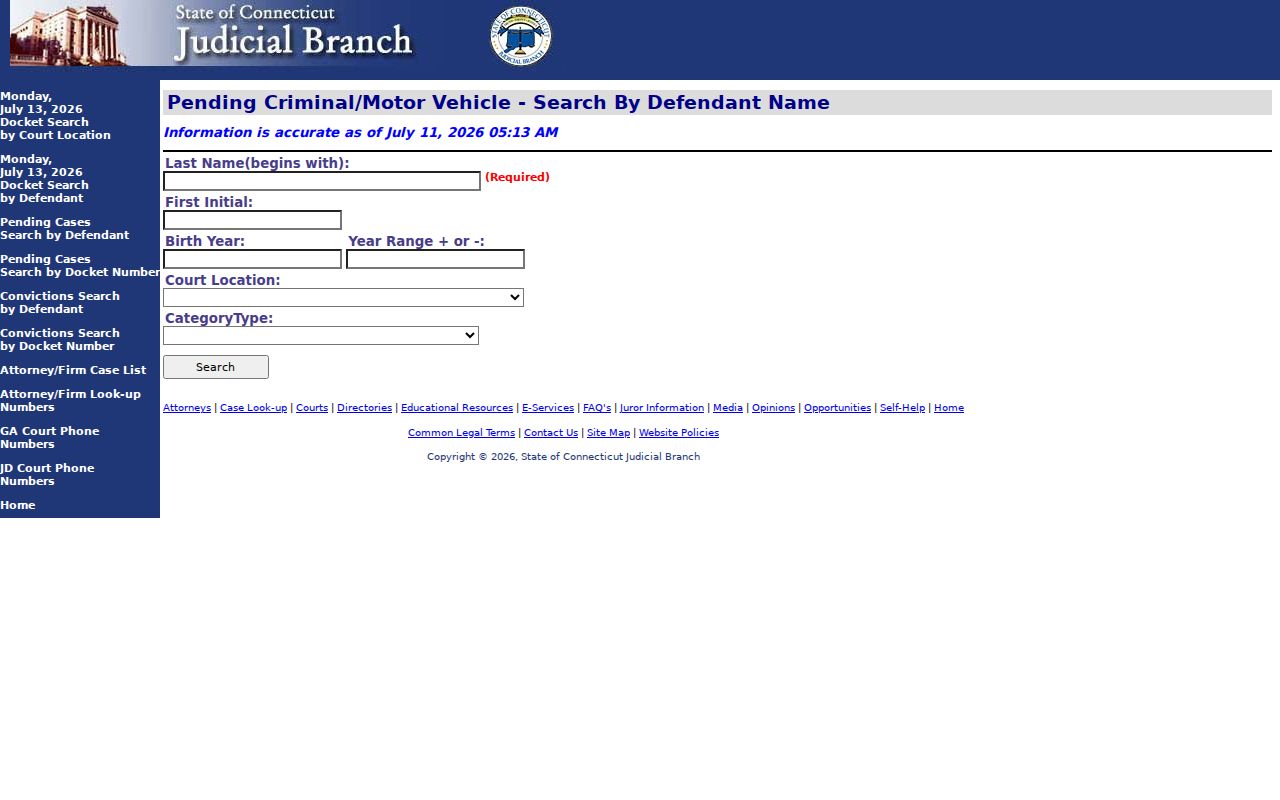
Pending search results can show that a Stamford matter is active even when the next court event is not on the current daily calendar.
The pending criminal and motor vehicle docket number search is the more precise path when the docket number is known.
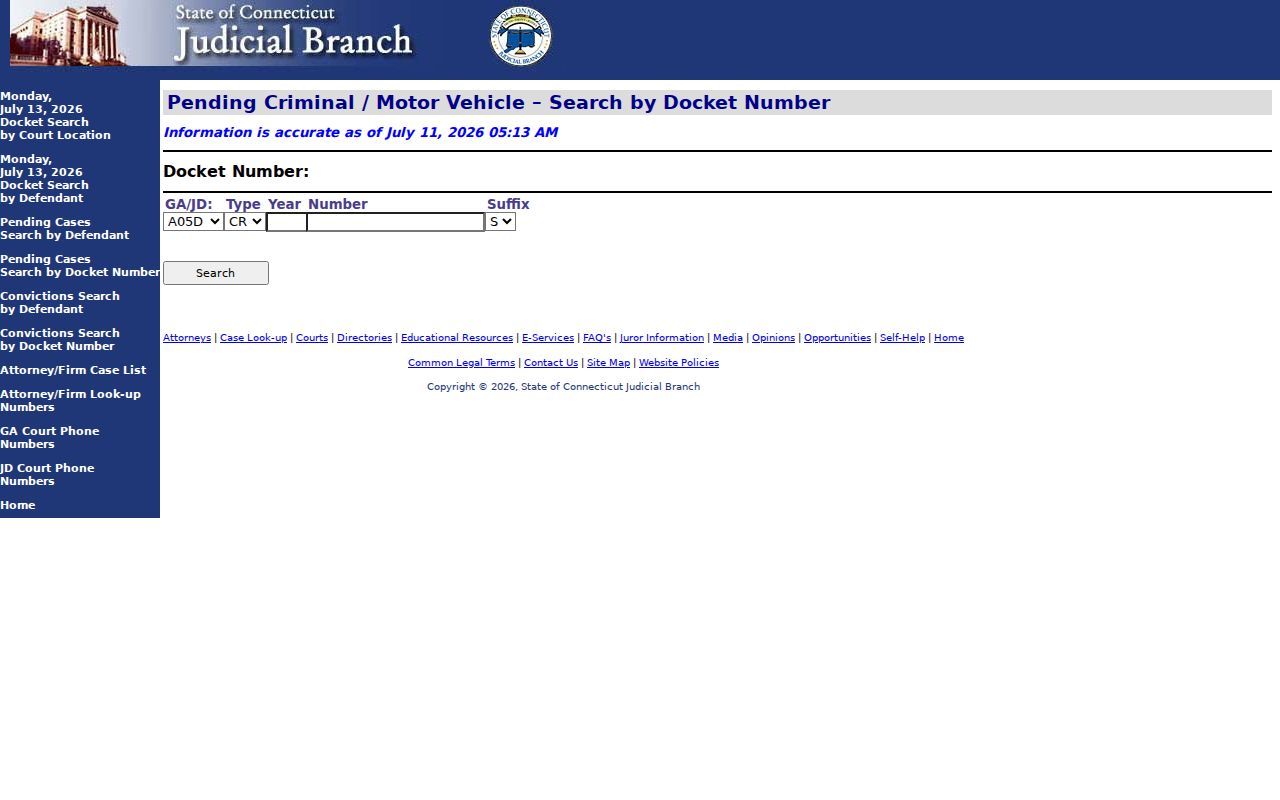
Docket-number lookup reduces the risk of confusing two defendants with similar names in the Stamford/Norwalk Judicial District.
Stamford Civil Court Events
Civil, family, housing, and small claims docket information is spread across civil inquiry searches and court-event tools. A party-name search helps locate the case. A docket-number search is better for a known file. Court-events search can confirm scheduled events by location or by docket. Legal notices can show notice dates, party captions, docket numbers, and document links for certain public notice items.
Use the Stamford Judicial District code or Stamford Housing Session when the case belongs in those locations. Family matters such as dissolution of marriage, custody, relief from abuse, and parentage may appear in civil inquiry, but some details are restricted when safety, children, finances, sealed filings, or confidentiality rules apply.
| Docket or Notice Field | What It Shows |
|---|---|
| Court or Location | Stamford JD, Stamford Housing Session, or another Connecticut court location. |
| Notice Dates | Start and end dates for a public legal notice where listed. |
| Party or Title | Caption text such as petitioner v. respondent, plaintiff v. defendant, creditor notice, or estate-related notice. |
| Docket Number | Identifier with location prefix, case category, year, sequence, and suffix when shown. |
| Document Link | A public notice image or document link, not necessarily the full court file. |
Stamford Courts With Dockets
The Stamford/Norwalk Judicial District and G.A. 1 at Stamford share the 123 Hoyt Street courthouse, but they serve different docket functions. The judicial district handles civil, family, housing, serious criminal, and other judicial district matters. G.A. 1 handles many criminal, arraignment, motor vehicle, and lower-level criminal matters. Probate Court is separate and uses Connecticut Probate systems for covered estate and trust matters.
- Stamford/Norwalk Judicial District: civil, family, housing, serious criminal, and judicial district dockets.
- Geographical Area 1 at Stamford: criminal, motor vehicle, arraignment, and many G.A. docket matters.
- Stamford Housing Session: housing matters visible through civil inquiry location filters.
- Stamford Probate Court: decedent estates and trusts through Probate Case Lookup, with limited online coverage.
- Centralized Infractions Bureau: payable ticket records before a contested or missed-response matter transfers to court.
The criminal and motor vehicle conviction search by defendant is a separate lookup for disposed conviction information.
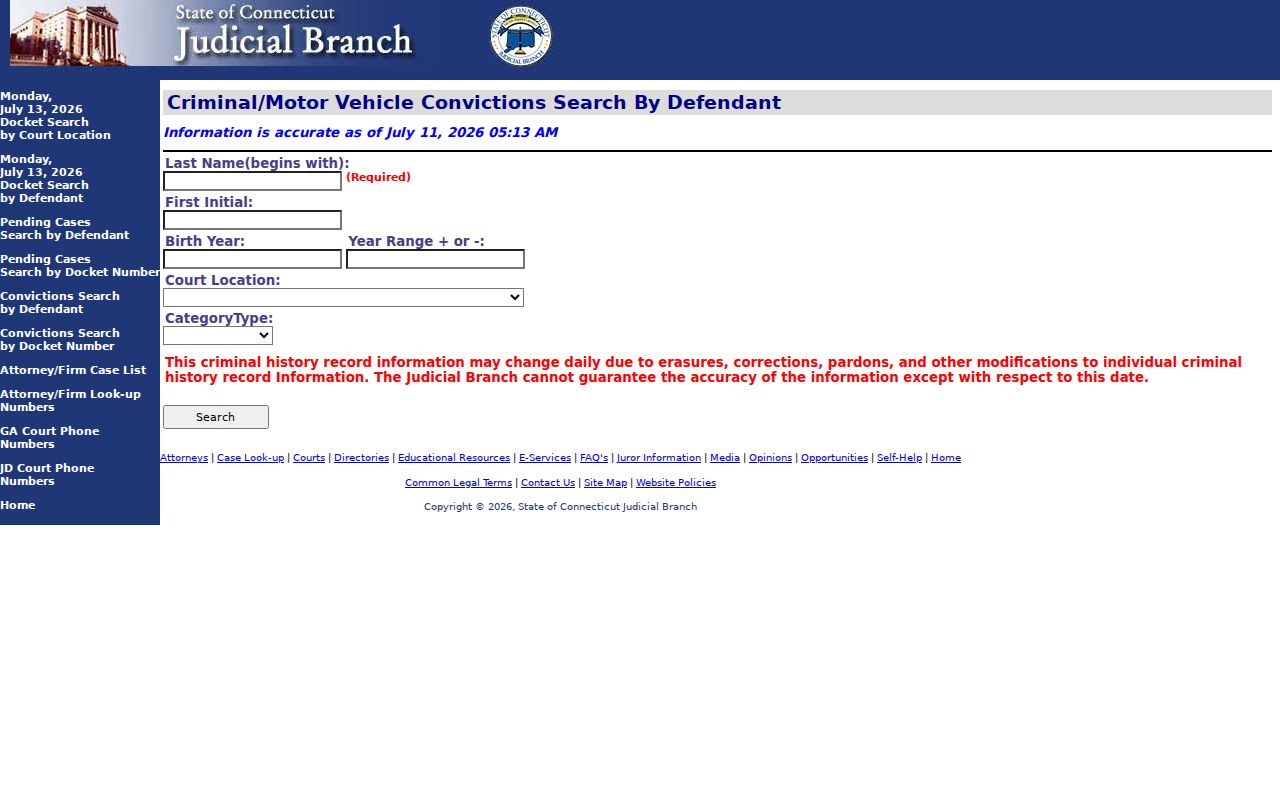
Conviction search is not the same as a pending docket search, and the Judicial Branch warns that criminal-history information may change after erasures, corrections, pardons, or modifications.
Stamford Docket vs Case Record
A docket is best for tracking case movement. The full case record is better for legal review, certified copies, final judgments, and complete filings. Stamford online tools may show public index data without exposing every underlying document. Exhibits, transcripts, older files, sealed filings, and certified copies often require a clerk request.
| Docket | Full Case Record | |
|---|---|---|
| Format | List of events, dates, parties, notices, or case status. | Documents, filings, orders, judgments, exhibits, and certified copies when available. |
| Access | Often free through Judicial Branch lookup tools. | May require clerk review, payment, ID, or court authorization. |
| Best Use | Confirm court date, case location, pending status, or disposition. | Read the legal filing, prove outcome, or obtain an official copy. |
| Limits | May omit sealed or restricted detail. | May still be limited by sealing, erasure, juvenile confidentiality, or privacy rules. |
Reading Stamford Docket Numbers
Connecticut docket numbers often include a location prefix, a case category, a two-digit year, a sequence number, and a suffix. Civil and family examples in public legal notices may show formats like a three-letter location prefix, category code, year, seven-digit sequence, and suffix. Stamford matters may use Stamford Judicial District or G.A. location signals in dropdowns and docket references.
Common docket terms include plaintiff, defendant, petitioner, respondent, motion, order, judgment, disposition, continuance, plea, sentence, and bond. A disposition is the outcome of a case or charge. A continuance is a postponed hearing. A nolo contendere plea means no contest; the Judicial Branch traffic FAQ states that paying a ticket is treated as no contest and has a similar legal effect as guilty.
Note: A docket entry can confirm an event, but official proof often requires a certified copy from the clerk.
The Stamford law library staff and location page identifies public legal research support at the courthouse.
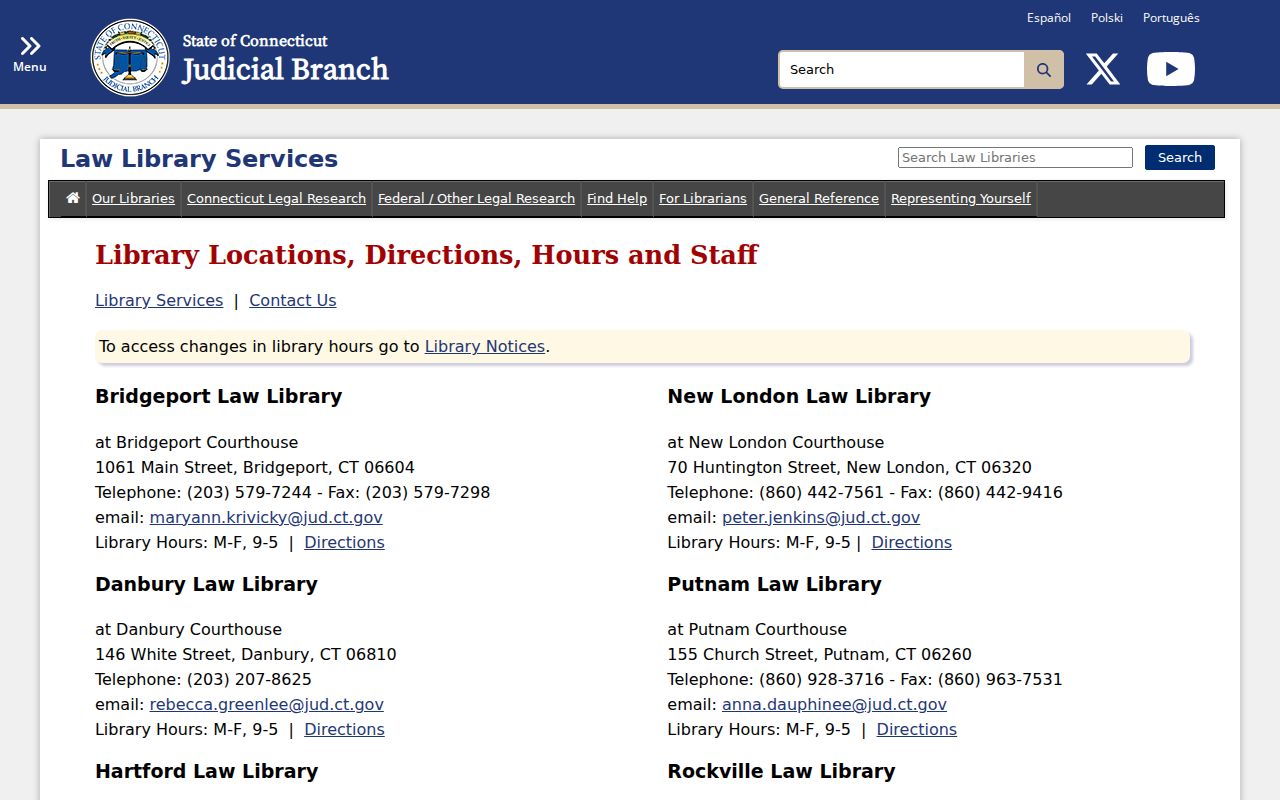
The law library can support research on court terms and procedure, while case-specific copy and certification questions still go to the clerk.